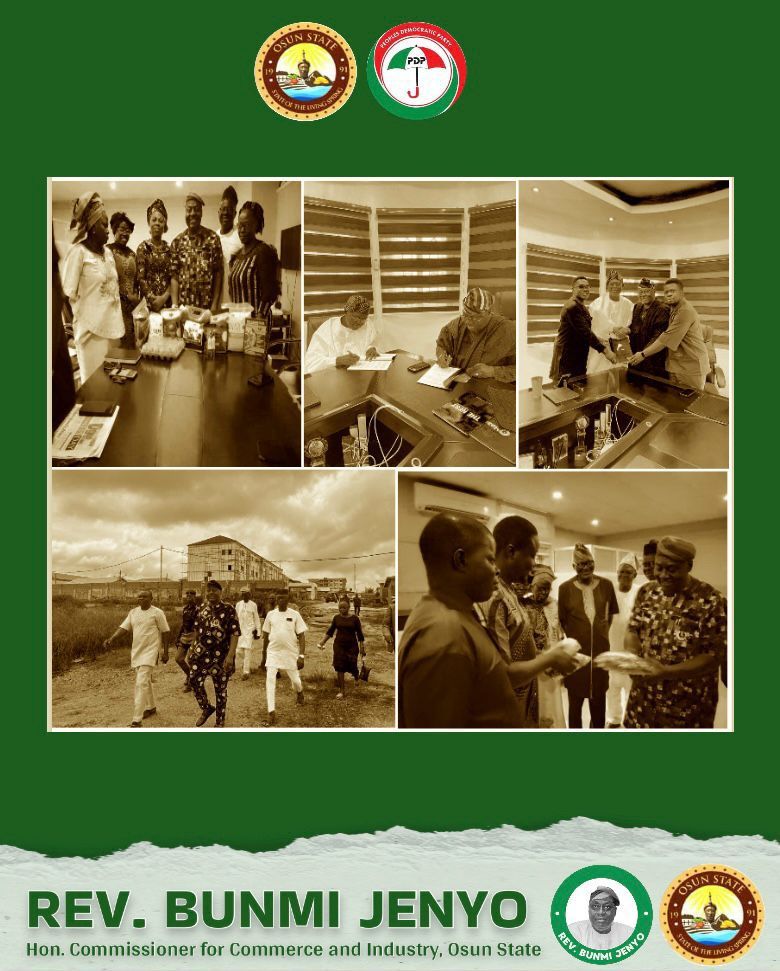
OSUN STATE MINISTRY OF COMMERCE AND INDUSTRY
Strengthening Osun’s Economy Through Realistic and Inclusive Growth
The Ministry of Commerce and Industry in Osun State remains committed to building a supportive environment for business and sustainable industrial growth. Under the leadership of the Honourable Commissioner, Rev. Bunmi Jenyo, efforts have been focused on practical, achievable and relentless steps to strengthen economic opportunities for residents across the state. With Osun’s natural strengths—its people, resources, and strategic location—there is real potential to grow the local economy in ways that are inclusive and sustainable.
Small and medium-sized enterprises continue to form the backbone of the state’s economic activity. From local traders and artisans to small manufacturers and service providers, these enterprises play a vital role in community livelihoods and job creation. The Ministry has continued to support this sector through community engagement, access to capital structures, and information-sharing on business development. While access to capital remains a common challenge, encouraging collective savings and low-interest borrowing through Bank of Industry (BOI) has made a meaningful difference for many.
Steps have also been taken to encourage more business owners to formalize their operations. Making business registration and related processes simpler helps entrepreneurs gain visibility, build credibility, and benefit from existing government and private-sector programmes. Improvements in this area are ongoing, with attention given to transparency and reducing unnecessary delays.
As digital tools become more relevant in today’s economy, the Ministry has been helping small businesses and traders understand how mobile banking, online sales, and basic digital promotion can support growth. In many communities, awareness is increasing, and more entrepreneurs are beginning to embrace new ways of reaching customers and managing their finances.
Industrial development, though still at a growing stage in the state, is another area receiving attention. Osun has potentials, particularly in agro-processing linked to crops like cassava, maize, and oil palm. Supporting small-scale processing initiatives has not only improved local productivity but also helped reduce post-harvest losses. Collaboration with relevant agencies, farmer groups and technical partners continues to guide these efforts.
There are also reviews underway to assess how existing industrial sites and facilities can be revitalized or better utilized. These discussions are handled with care, with priority placed on transparency, due diligence, and long-term benefit for the state. Encouraging the right kind of investment—one that respects the local content and delivers value to communities—is central to this approach.
Infrastructure remains a challenge in some rural areas, particularly in relation to power supply and road networks. These issues affect the speed at which businesses can grow or industrial activities can expand. The ministry, alongside other arms of government, continues to advocate for gradual improvements and explore local solutions where possible. These efforts, while ongoing, are part of a wider plan to create a more supportive environment for both small and larger businesses.
In the aforementioned, kudos must be given to the people’s Governor, Sen. Ademola Jackson Nurudeen Adeleke, who has surpassed his predecessors, in completely eschewing the infrastructural deficit inherited from the previous administration. The giant strides of Governor Adeleke in road construction and rehabilitation across the State is verifiable, conspicuous and sustainable, without borrowing a dime.
Also, Osun State Living Spring Free Trade Zone, which was abandoned by successive administrations of the State, has now been resuscitated, by the Ministry under the able leadership of the Governor.
Osun’s public markets have also benefited from targeted interventions. Selected markets have received support in the form of roofing repairs, stall arrangements, drainage upgrades, and sanitation improvements. These efforts aim to improve the overall trading experience and promote a clean, safe and organized market atmosphere. Working closely with market leaders and unions ensures that projects are aligned with the actual needs of traders and their customers.
Some Federal Government Agencies such as NANO, SMEDAN, etc have continued to play an important role in grassroots economic empowerment. Many traders and artisans, especially women, have accessed grants, soft loans and training through well-organized, Skills Acquisition and Entrepreneurship Development, by the Ministry of Commerce and Industry. These structures have proven to be effective tools for building resilience, reducing dependency, and promoting shared progress within communities.
Osun’s location offers real opportunities for regional trade, and efforts are underway to strengthen connections with nearby states. Improving logistics, expanding access to local produce, and supporting cross-border commerce are part of the ministry’s broader vision to open more channels of trade for Osun-based businesses.
Youth empowerment remains a priority. The ministry has partnered with vocational centers, NGOs, and community groups to deliver training in areas such as tailoring, welding, hairdressing, baking, shoemaking, and ICT. Many young people have benefited, gaining the skills and confidence needed to start their own small enterprises. Support through tools, mentorship, and basic startup guidance continues to be provided where possible.
The Osun Industrial Investment Summit 2024 continues to be pointed as a reference point for the opening of ways by which economic transformation of the State can be achieved. The Ministry, in collaboration with other agencies of government in the sector, has been working ceaselessly to engage investors and facilitate responsible partnerships across key sectors like agriculture, tourism, and manufacturing. While not every enquiry results in an investment, many conversations have laid the foundation for future collaboration. Transparency and mutual respect remain guiding values in these engagements.
Throughout all activities, inclusion remains central. Women, persons with disabilities, and underserved communities are being given deliberate attention, with efforts made to ensure broad access to programmes and opportunities. Economic development must reflect the diversity and dignity of the people it serves.
The road is not without challenges. Like many states, Osun faces constraints around funding, infrastructure, and administrative bottlenecks. However, through steady planning, focused action, and partnership with communities, progress is being made. The ministry remains committed to listening, learning, and adjusting its approach where necessary.
In moving forward, everyone has a role to play. Government, private sector players, civil society, youth, and community leaders must all work together to unlock Osun’s economic potential. By focusing on what is real, sustainable, and inclusive, the state can continue to make quiet but meaningful progress that touches lives and strengthens the future.

 Site Title