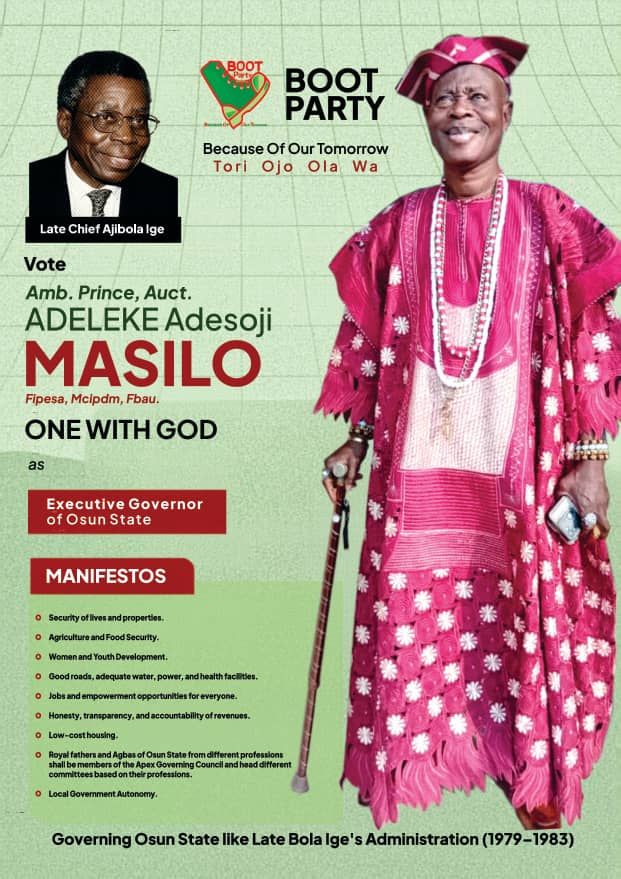
OSUN 2026: BOOT PARTY CANDIDATE, ADESOJI MASILO, TASKS INEC TO TRACK ELECTION MATERIALS FROM CBN TO EACH POLLING UNIT
The governorship candidate of the Because Of Our Tomorrow (BOOT) party, Ambassador Hon. Prince Auct. Adesoji Masilo Adeleke has tasked the Independent National Electoral Commission (INEC) to introduce real-time tracking of election materials from the Central Bank of Nigeria (CBN) to their different locations across Osun State.
The assertion was made in Osogbo, the State Capital on Tuesday to alert the electoral umpire of the sanctity of the credibility of the forthcoming polls on Saturday.
In an exclusive interview with the National Chairman of the party, Sonny Adenuga recently, issues were raised concerning the development, excerpts:
Osun Governorship Election: BOOT Party Urges INEC to Introduce Real-Time Tracking of Election Materials and Establish an Electoral Logistics Corps (ELC)
INEC Has Strengthened the Electoral Process — Now Strengthen Logistics Accountability
The BOOT Party has called on the Independent National Electoral Commission (INEC) to strengthen election logistics by ensuring that every vehicle transporting sensitive election materials and electoral personnel is continuously traceable in real time from departure to destination during the forthcoming Osun State Governorship Election on 15 August 2026 and the 2027 General Elections.
INEC has made important advances in Nigeria’s electoral process through BVAS, electronic accreditation and improvements in result management. But electoral integrity does not begin and end at the polling unit or with the counting of votes.
The next frontier is logistics accountability.
The BOOT Party therefore proposes two complementary measures:
Mandatory real-time tracking of vehicles transporting election personnel and sensitive materials; and
The establishment of an Electoral Logistics Corps (ELC) within INEC’s operational framework.
The immediate measure can strengthen accountability now. The ELC would provide the long-term institutional solution.
Why Real-Time Logistics Tracking Matters in Osun
Osun has demonstrated how competitive governorship elections can be.
In the 2018 Osun governorship election, Gboyega Oyetola received 255,505 votes while Ademola Adeleke received 255,023 votes, giving Oyetola a margin of only 482 votes after the supplementary election.
In 2022, Ademola Adeleke defeated Gboyega Oyetola by 28,344 votes, receiving 403,371 votes against Oyetola’s 375,027 votes.
These results demonstrate that Osun can produce closely contested elections in which relatively small differences in voter participation can matter.
A delay affecting one polling unit may have little significance on its own. But unexplained or repeated delays across multiple polling units can affect when voting begins, how long voters have to participate and whether election officials and sensitive materials arrive as planned.
This does not mean that every delay is electoral manipulation. It means that every significant delay should be traceable, explainable and auditable.
Election Manipulation Goes Beyond Ballot-Box Snatching
Electoral malpractice is not limited to ballot-box snatching, multiple voting or interference with ballot counting.
Potential vulnerabilities can also arise through deliberate obstruction, unexplained logistical delays, diversion from planned routes, unauthorised stops, delayed deployment of election officials, late delivery of sensitive materials or other disruptions that affect the ability of voters to participate.
The existence of a delay, diversion or breakdown does not by itself establish wrongdoing.
The problem arises when there is no reliable record showing what happened, where it happened, when it happened and why it happened.
That is the accountability gap that technology can help close.
From “Trust Us” to “Show Us the Evidence”
INEC already has logistics-management and monitoring arrangements, and the Commission has previously used technology to support election logistics.
The BOOT Party is not proposing that INEC start from scratch.
Rather, INEC should strengthen its existing arrangements by making vehicle-level, real-time visibility a standard requirement for the movement of sensitive election materials and electoral personnel.
Every designated vehicle should have a verifiable digital trail showing:
This would transform logistics monitoring from a largely retrospective exercise into real-time operational accountability.
The Immediate Safeguard: Real-Time Vehicle Tracking
For the Osun election and other elections where appropriate technology is not already providing sufficient coverage, INEC should require every designated vehicle to be continuously trackable throughout its assigned journey.
Where existing INEC systems provide this capability, those systems should remain the primary platform.
Where a supplementary mechanism is required, simple tools such as WhatsApp Live Location could provide an additional layer of visibility for authorised INEC supervisors.
The driver and designated INEC official could activate live location before departure and share it with an authorised monitoring account.
The objective is not to replace INEC’s existing technology.
It is to ensure that no vehicle carrying sensitive election materials becomes operationally invisible between departure and destination.
Significant route deviations, prolonged unexplained stops, communication interruptions or late arrivals should trigger appropriate verification and documentation.
The Long-Term Solution: An Electoral Logistics Corps
The BOOT Party believes that Nigeria should move beyond an election-by-election approach to electoral transportation. Election logistics is too important to depend primarily on temporary transportation arrangements assembled for each election.
We therefore propose the establishment of an Electoral Logistics Corps (ELC) within INEC’s operational framework as a permanent, professionally managed and INEC-controlled electoral logistics function.
The ELC would be responsible for the end-to-end management, coordination and oversight of electoral logistics, including:
The ELC would provide direct operational control and accountability to INEC, while allowing the Commission to leverage private-sector capacity where appropriate.
INEC would not necessarily need to own all the vehicles. Instead, the Commission could establish a panel of professionally managed fleet companies through transparent, competitive and strictly regulated multi-year framework agreements.
These contracted fleet operators would provide vehicles and drivers in accordance with INEC’s defined operational standards, including real-time tracking, designated routes, communication requirements, vehicle identification, delivery confirmation and auditable journey records.
This model would give INEC the advantages of commercial fleet capacity without surrendering operational control.
The distinction is important: the vehicles may be privately provided, but the logistics operation must remain under INEC’s control.
The ELC would therefore become the permanent institutional mechanism through which INEC plans, coordinates, monitors and audits the movement of electoral personnel and sensitive materials before, during and after elections.
Nigeria needs an electoral logistics system that is professional, technology-enabled, continuously monitored and directly accountable to INEC—not a temporary transportation arrangement recreated for every election.
The Transportation Union Challenge
INEC’s current logistics arrangements rely significantly on transportation associations and the cooperation of major transport unions to provide vehicles.
Such arrangements can provide access to a large pool of vehicles, but they can also create challenges around consistency, accountability, operational control and standardisation.
The interests and operating structures of transportation organisations do not necessarily align completely with INEC’s requirements for a tightly controlled election-day logistics operation.
A professional Electoral Logistics Corps would allow INEC to set the operational standards while contracted fleet operators simply provide capacity under clearly defined obligations.
From Real-Time Monitoring to Post-Election Audit
Real-time tracking should not end when the election ends.
INEC should retain appropriate logistics records as part of a structured post-election logistics audit.
These records could help answer critical questions:
This evidence would allow INEC to distinguish genuine operational difficulties from unexplained failures or potential misconduct.
It would also allow the Commission to identify recurring logistical weaknesses and correct them before the next election.
Protect the Voter Before Protecting the Ballot
Electoral integrity begins before the voter reaches the polling unit.
Protecting the ballot is essential. But so is ensuring that the polling unit opens on time, election officials arrive as scheduled and sensitive materials reach their destinations securely and within the required timeframe.
The BOOT Party therefore urges INEC to make real-time logistics accountability a core component of election management, beginning with Osun and developing it into a permanent national standard.
The immediate priority should be clear:
Track every designated vehicle. Record every significant deviation. Explain every significant delay. Audit every journey.
The long-term solution should be equally clear:
Establish an Electoral Logistics Corps capable of delivering professional, technology-enabled and accountable election logistics across Nigeria.

 Site Title